

If you own a 2008-2010 Ford Super Duty with the 6.4L Powerstroke, you know exactly what I’m talking about. On paper, it’s a beast—twin turbos, common-rail injection, and enough torque to pull a house off its foundation. But in reality? It often feels like a world-class athlete trying to run a marathon while breathing through a cocktail straw.
The 6.4L was the first Ford diesel to deal with heavy DPF (Diesel Particulate Filter) requirements, and frankly, the factory execution was flawed. Between the constant "regen" cycles, the massive heat buildup behind the turbos, and the fragile factory up-pipes, these trucks are essentially ticking time bombs if left completely stock.
I recently went through a full "breathing overhaul" on my '09. I wanted to share the defects I found, the installation hurdles I cleared, and the parts I used to finally let this engine live to its potential.
Q: Will it pass inspection?A: Legal Disclaimer: Removing emissions equipment like the Catalytic Converter or DPF is strictly for off-road, competition, or export use only. It is a violation of the Clean Air Act to operate a "deleted" vehicle on public roads in the United States. Always check your local and state regulations before modifying your exhaust.
Q: Is 5-inch exhaust overkill?A: For a stock truck, 4-inch is usually enough. However, the 5-inch kit allows for much lower EGTs when towing heavy loads up a grade. If you ever plan on upgrading your injectors or turbos, you’ll want that 5-inch flow.
If you’re sitting on the fence, check your oil. If it smells like diesel or your level is "rising," your DPF is likely killing your engine. It's time to let that Powerstroke breathe.
What's your next move? If you're looking to start, I'd suggest checking out the full 5-inch kits first—it’s the single biggest change you can make to these trucks.
The 6.4L was the first Ford diesel to deal with heavy DPF (Diesel Particulate Filter) requirements, and frankly, the factory execution was flawed. Between the constant "regen" cycles, the massive heat buildup behind the turbos, and the fragile factory up-pipes, these trucks are essentially ticking time bombs if left completely stock.
I recently went through a full "breathing overhaul" on my '09. I wanted to share the defects I found, the installation hurdles I cleared, and the parts I used to finally let this engine live to its potential.
Part 1: The Factory Flaws (The "Why")
Before you start wrenching, you need to understand the three main killers of the 6.4L engine:- Exhaust Backpressure & Heat: The DPF acts like a massive plug in your exhaust. To clean it, the engine injects extra fuel on the exhaust stroke to superheat the filter. This causes massive EGT (Exhaust Gas Temperature) spikes, which are brutal on your turbos and cylinders.
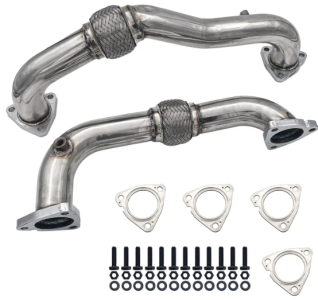
- The "Up-Pipe" Failure: The factory up-pipes (the pipes leading from the manifolds to the turbo) use thin, weak bellows. Over time, the heat cycles cause them to crack. You’ll hear a "hissing" or "whistling" sound, and you’ll see soot all over your firewall. This leads to lost boost and even more heat.
- Fuel Dilution: Frequent regeneration cycles often lead to unburnt diesel washing past the piston rings and into your oil. This thins your oil and can lead to catastrophic bearing failure.
Part 2: The Shopping List (Maximizing Flow)
I decided to go with parts from TruckTok. I’ve used them before because they tend to use T-409 and high-grade stainless steel rather than the cheap aluminized stuff that rusts out after one winter.1. The Foundation: Heavy Duty Up-Pipes
If you have a soot-covered firewall, stop right now and fix this. I replaced my leaking factory units with these heavy-duty stainless up-pipes.- The Upgrade: These use reinforced interlocking braided bellows. Unlike the factory ones that just "pop" under pressure, these are designed for high-flow durability. The precision-machined flanges made the alignment much easier during the install.
2. The "Unplugging": DPF & Cat Deletes
To solve the heat and backpressure issue, the factory DPF has to go. Depending on your goals (and how loud you want the truck), there are a few ways to do this:- The Budget/Stealth Route: If you want to keep the rest of your exhaust stock but remove the restriction, the 4-inch stainless delete pipe is the way to go. It fits right into the factory location and significantly reduces backpressure.
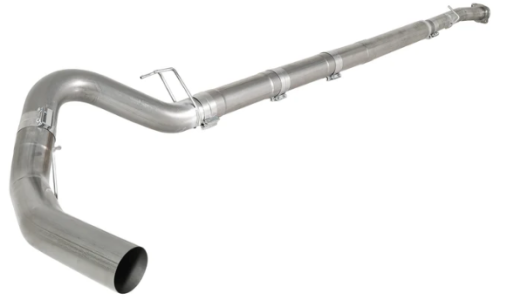
- The "Full Send" Route: For maximum performance and that deep diesel growl, I went with the 5-inch downpipe-back straight pipe. Going from a 4-inch stock system to a 5-inch stainless setup makes a massive difference in how fast the turbos spool.
- The "Refined" Route: If you tow long distances and don't want the "drone" to vibrate your skull, you can get the 5-inch system with an included muffler. It still flows just as well but keeps the exhaust note deep and mellow rather than raspy.
Part 3: Installation Tips (The "Hard Way")
Doing these mods on a 6.4L is a rite of passage. Here’s what you need to know:- The Up-Pipes: This is a tight job. You’ll be working behind the engine near the firewall. Pro-Tip: Removing the transmission dipstick tube and the downpipe will give you significantly more room to reach the bolts on the turbo collector.
- The Sensors: When removing the DPF, you’ll encounter several EGT sensors and a pressure sensor. Be extremely careful with the wiring harnesses. If you plan on using a tuner (which is mandatory for these mods), you won’t need the sensors in the new pipe, but you must secure the factory plugs so they don't melt or get full of mud.
- Soak Everything: The exhaust bolts on the 6.4L are notorious for snapping. Use PB Blaster or Kroil on every bolt 24 hours before you start. If you snap an up-pipe bolt in the manifold, you’re going to have a very bad weekend.
Part 4: The Results – Was it worth it?
After installing the HD Up-Pipes and the 5-inch exhaust, the difference was immediate.- Fuel Economy: My MPG jumped by about 3-4 miles per gallon. Why? Because the engine isn't wasting fuel on "Regen" cycles anymore.
- Engine Health: My oil stay clean. Without the exhaust being forced back into the system, fuel dilution has vanished.
- Performance: The turbo lag is nearly gone. The 6.4L twin-turbo setup reacts instantly now that it can actually breathe.
- The Sound: It sounds like a monster. The 5-inch pipe gives it a deep, low-frequency rumble that makes the truck feel much more substantial.
Part 5: Common Questions & FAQ
Q: Do I need a tuner?A: YES. If you install a delete pipe without a "delete-capable" tuner (like an SCT or Mini Maxx with custom tunes), the truck will immediately go into "Limp Mode." The computer will think the DPF is missing or broken and will cut your power to 50%.Q: Will it pass inspection?A: Legal Disclaimer: Removing emissions equipment like the Catalytic Converter or DPF is strictly for off-road, competition, or export use only. It is a violation of the Clean Air Act to operate a "deleted" vehicle on public roads in the United States. Always check your local and state regulations before modifying your exhaust.
Q: Is 5-inch exhaust overkill?A: For a stock truck, 4-inch is usually enough. However, the 5-inch kit allows for much lower EGTs when towing heavy loads up a grade. If you ever plan on upgrading your injectors or turbos, you’ll want that 5-inch flow.
Final Thoughts
The 6.4L is one of the most capable engines Ford ever put in a truck, but it was suffocated by early emissions technology. By upgrading to reinforced up-pipes and a high-flow exhaust system, you are essentially letting the engine "relax." It runs cooler, lasts longer, and sounds incredible.If you’re sitting on the fence, check your oil. If it smells like diesel or your level is "rising," your DPF is likely killing your engine. It's time to let that Powerstroke breathe.
What's your next move? If you're looking to start, I'd suggest checking out the full 5-inch kits first—it’s the single biggest change you can make to these trucks.
Last edited:
