

Let's be precise about what we're discussing. The 2011-2016 LML Duramax represents a pivotal moment in the 6.6L lineage. It introduced a high-pressure common-rail system with piezo injectors, a CP4.2 pump, and a more complex emissions architecture that combined cooled EGR with a Diesel Exhaust Fluid (DEF) system. The engine makes impressive power and torque numbers straight from the factory. But beneath those numbers lies a fundamental engineering tension: the EGR system, while effective at reducing NOx for regulatory compliance, introduces a series of thermodynamic and mechanical compromises that directly oppose long-term engine durability.
This isn't about whether you can keep the EGR system intact. Of course you can. Thousands of trucks operate with them every day. The question is about the technical trade-offs you accept by doing so. What is the actual cost, in terms of thermal load, contamination, and component stress, of maintaining that system? And how does a properly engineered delete address those costs at a mechanical level?
The LML's EGR system is a cooled design. It taps exhaust gas from the manifold, routes it through an EGR cooler—a heat exchanger that uses engine coolant to pull heat out of the exhaust—and then passes that cooled, inert gas through an electronically controlled valve and into the intake manifold .
On paper, this works. In practice, it creates a cascade of unintended consequences.
The thermodynamic reality: You are routing 1,000°F+ exhaust gas through a component that is, at its core, a radiator immersed in your engine's coolant. That heat has to go somewhere. It goes into your cooling system. The EGR cooler acts as an additional heat load on the radiator, forcing the cooling system to work harder to maintain normal operating temperatures .
The EGR cooler is subjected to extreme thermal cycling. It heats rapidly when exhaust flows through it and cools when the engine shuts off. Over time, this constant expansion and contraction stresses the metal, particularly at the tube-to-header joints where dissimilar materials meet .
When an EGR cooler cracks—and this is a documented failure mode on the LML, though not as notorious as on the 6.0L Powerstroke—it creates a direct communication path between the exhaust system and the cooling system .
The consequences are binary but equally destructive:
Failure Mode 2: Carbon Fouling and the "Wet Stack" Phenomenon
The EGR system recirculates soot. This is unavoidable. That soot, combined with the inevitable trace amounts of oil vapor from the CCV system, creates a sticky, carbonaceous deposit that accumulates in the EGR valve, the intake manifold, and the cylinder head ports .
On the LML, this is exacerbated by the fact that the engine, like all modern diesels, is calibrated to run lean and clean. But the EGR system introduces particulate matter directly into the intake stream. Over 50,000, 100,000, or 150,000 miles, that accumulation reduces the effective cross-sectional area of the intake tract. The engine has to work harder to ingest the same mass of air. This is a direct loss of volumetric efficiency .
The EGR valve itself is a precision component. Its pintle is designed to seat perfectly against its bore. Carbon buildup prevents this. A valve that cannot close fully creates a continuous recirculation loop, leading to rough idle, surging, and eventually, diagnostic trouble codes . A valve that sticks open or closed requires replacement.
Failure Mode 3: Elevated Exhaust Gas Temperatures (EGTs)
This is counterintuitive to some, but the EGR system, by introducing hot, inert gas into the combustion chamber, actually increases the thermal load on the engine in several ways.
First, the inert gas displaces oxygen. To maintain power output, the engine must inject more fuel, which generates more heat. Second, a partially clogged EGR cooler fails to lower the temperature of the recirculated gas, meaning hotter gas is being reintroduced. Third, the restriction of the EGR system in the exhaust flow path increases backpressure, which forces the turbocharger to work harder and raises drive pressures .
The result is higher EGTs under load. Higher EGTs are the enemy of turbocharger longevity. Sustained high EGTs can also exceed the thermal limits of pistons and valves, leading to cracking or melting in extreme cases .
Benefit 1: Coolant System Thermal Load Reduction
The EGR cooler is removed from the cooling circuit. The coolant lines are re-routed using a bypass hose, which reconnects the supply and return. This is not just a simplification; it is a thermal efficiency improvement. The coolant no longer absorbs heat from the exhaust. That heat stays in the exhaust stream and exits through the tailpipe .
Quantifiable result: Lower overall coolant temperatures, particularly under sustained load. The cooling system can focus entirely on its primary function: managing engine heat, not waste heat from a recirculation system.
Benefit 2: Intake Air Quality Restoration
With the exhaust manifold port sealed by a precision stainless steel block-off plate, the flow of soot-laden exhaust gas into the intake is permanently stopped. The engine breathes only clean, filtered air.
Quantifiable result: Elimination of future carbon buildup in the intake manifold, on the valves, and in the turbocharger. Existing carbon remains, but the source of new carbon is removed. This preserves volumetric efficiency over the long term.
Benefit 3: EGT Reduction and Turbo Efficiency Improvement
Removing the EGR system eliminates a significant restriction in the exhaust path. Exhaust gases flow more freely from the manifolds to the turbocharger. This reduces backpressure, which allows the turbine to spool more efficiently. Lower backpressure also reduces the work required of the engine to expel exhaust gases during the exhaust stroke, a loss known as "pumping work" .
Quantifiable result: Lower EGTs under load, improved throttle response, and faster turbo spool. The reduction in EGTs is not trivial; owners consistently report drops of 100-200°F under heavy towing conditions .
Benefit 4: Material Superiority
Factory EGR components are manufactured to a price point. They use cast iron and mild steel that are susceptible to corrosion and fatigue. A quality delete kit uses billet aluminum and stainless steel. These materials offer superior resistance to thermal cycling and corrosion. They are designed to be permanent, not consumable .
Without a custom calibration (tune), the following occurs:
Where the gains come from:
For owners who operate in jurisdictions without emissions testing and who are willing to accept the legal responsibility, the technical case for deletion is robust. It is not about "defeating" a system; it is about removing components that introduce heat, contamination, and failure points into an otherwise durable engine architecture.
If you've followed the technical breakdown above, the conclusion almost writes itself. The TruckTok LML EGR Delete Kit is precisely what a proper delete solution should be: complete, material-appropriate, and designed for permanent installation. It uses stainless steel for the exhaust block-off plate and CNC-machined billet aluminum for the intake closing plate—materials that actually outlast the truck, not just meet a price point.
What distinguishes this kit from generic solutions is that it allows you to remove both the EGR valve and the cooler while retaining your factory intake and exhaust manifolds. That means no unnecessary fabrication, no hacking up factory components, and a cleaner installation overall. The three-terminal cooling hose re-routes coolant flow correctly, eliminating the cooler as both a heat source and a potential failure point. The included clamps and fasteners mean you're not hunting for hardware at the last minute.
For the 2011-2016 LML owner who understands the thermal and contamination costs of the stock EGR system, this kit addresses those issues at the source. It lowers coolant temperatures, prevents carbon ingestion, and removes a component that is fundamentally subject to fatigue. When paired with proper tuning, it transforms the engine's operating environment from one of regulatory compromise to one of mechanical efficiency.
If you've deleted the EGR on your LML, what changes did you notice in coolant temps, EGTs, or long-term durability—drop your experience below.
This isn't about whether you can keep the EGR system intact. Of course you can. Thousands of trucks operate with them every day. The question is about the technical trade-offs you accept by doing so. What is the actual cost, in terms of thermal load, contamination, and component stress, of maintaining that system? And how does a properly engineered delete address those costs at a mechanical level?
Part 1: The EGR System's Role in the LML Architecture
To understand the problem, we have to start with first principles. The 6.6L Duramax is a compression-ignition engine. It produces power by compressing air to temperatures high enough that injected fuel ignites spontaneously. The byproduct of this process, at high combustion temperatures, is the formation of oxides of nitrogen (NOx). The EGR system's mandate is to lower those peak combustion temperatures by introducing inert exhaust gas into the intake stream .The LML's EGR system is a cooled design. It taps exhaust gas from the manifold, routes it through an EGR cooler—a heat exchanger that uses engine coolant to pull heat out of the exhaust—and then passes that cooled, inert gas through an electronically controlled valve and into the intake manifold .
On paper, this works. In practice, it creates a cascade of unintended consequences.
The thermodynamic reality: You are routing 1,000°F+ exhaust gas through a component that is, at its core, a radiator immersed in your engine's coolant. That heat has to go somewhere. It goes into your cooling system. The EGR cooler acts as an additional heat load on the radiator, forcing the cooling system to work harder to maintain normal operating temperatures .
Part 2: The Technical Failure Modes of the LML EGR System
Failure Mode 1: EGR Cooler Thermal Fatigue and CrackingThe EGR cooler is subjected to extreme thermal cycling. It heats rapidly when exhaust flows through it and cools when the engine shuts off. Over time, this constant expansion and contraction stresses the metal, particularly at the tube-to-header joints where dissimilar materials meet .
When an EGR cooler cracks—and this is a documented failure mode on the LML, though not as notorious as on the 6.0L Powerstroke—it creates a direct communication path between the exhaust system and the cooling system .
The consequences are binary but equally destructive:
- If coolant pressure exceeds exhaust pressure: Coolant is drawn into the exhaust stream. It burns off as white smoke, and you lose coolant with no visible external leak.
- If exhaust pressure exceeds coolant pressure: Combustion gases are forced into the cooling system. This pressurizes the coolant, can cause overheating, and in severe cases, can push coolant out the overflow or force exhaust into the heater core .
Failure Mode 2: Carbon Fouling and the "Wet Stack" Phenomenon
The EGR system recirculates soot. This is unavoidable. That soot, combined with the inevitable trace amounts of oil vapor from the CCV system, creates a sticky, carbonaceous deposit that accumulates in the EGR valve, the intake manifold, and the cylinder head ports .
On the LML, this is exacerbated by the fact that the engine, like all modern diesels, is calibrated to run lean and clean. But the EGR system introduces particulate matter directly into the intake stream. Over 50,000, 100,000, or 150,000 miles, that accumulation reduces the effective cross-sectional area of the intake tract. The engine has to work harder to ingest the same mass of air. This is a direct loss of volumetric efficiency .
The EGR valve itself is a precision component. Its pintle is designed to seat perfectly against its bore. Carbon buildup prevents this. A valve that cannot close fully creates a continuous recirculation loop, leading to rough idle, surging, and eventually, diagnostic trouble codes . A valve that sticks open or closed requires replacement.
Failure Mode 3: Elevated Exhaust Gas Temperatures (EGTs)
This is counterintuitive to some, but the EGR system, by introducing hot, inert gas into the combustion chamber, actually increases the thermal load on the engine in several ways.
First, the inert gas displaces oxygen. To maintain power output, the engine must inject more fuel, which generates more heat. Second, a partially clogged EGR cooler fails to lower the temperature of the recirculated gas, meaning hotter gas is being reintroduced. Third, the restriction of the EGR system in the exhaust flow path increases backpressure, which forces the turbocharger to work harder and raises drive pressures .
The result is higher EGTs under load. Higher EGTs are the enemy of turbocharger longevity. Sustained high EGTs can also exceed the thermal limits of pistons and valves, leading to cracking or melting in extreme cases .
Part 3: The Thermodynamic Benefits of EGR Deletion
A properly engineered EGR delete kit, such as one utilizing CNC-machined billet aluminum and stainless steel components, addresses these failure modes by removing the root causes entirely.Benefit 1: Coolant System Thermal Load Reduction
The EGR cooler is removed from the cooling circuit. The coolant lines are re-routed using a bypass hose, which reconnects the supply and return. This is not just a simplification; it is a thermal efficiency improvement. The coolant no longer absorbs heat from the exhaust. That heat stays in the exhaust stream and exits through the tailpipe .
Quantifiable result: Lower overall coolant temperatures, particularly under sustained load. The cooling system can focus entirely on its primary function: managing engine heat, not waste heat from a recirculation system.
Benefit 2: Intake Air Quality Restoration
With the exhaust manifold port sealed by a precision stainless steel block-off plate, the flow of soot-laden exhaust gas into the intake is permanently stopped. The engine breathes only clean, filtered air.
Quantifiable result: Elimination of future carbon buildup in the intake manifold, on the valves, and in the turbocharger. Existing carbon remains, but the source of new carbon is removed. This preserves volumetric efficiency over the long term.
Benefit 3: EGT Reduction and Turbo Efficiency Improvement
Removing the EGR system eliminates a significant restriction in the exhaust path. Exhaust gases flow more freely from the manifolds to the turbocharger. This reduces backpressure, which allows the turbine to spool more efficiently. Lower backpressure also reduces the work required of the engine to expel exhaust gases during the exhaust stroke, a loss known as "pumping work" .
Quantifiable result: Lower EGTs under load, improved throttle response, and faster turbo spool. The reduction in EGTs is not trivial; owners consistently report drops of 100-200°F under heavy towing conditions .
Benefit 4: Material Superiority
Factory EGR components are manufactured to a price point. They use cast iron and mild steel that are susceptible to corrosion and fatigue. A quality delete kit uses billet aluminum and stainless steel. These materials offer superior resistance to thermal cycling and corrosion. They are designed to be permanent, not consumable .
Part 4: The Tuning Imperative – System Integration
It is critical to understand that hardware deletion is only half of the solution. The LML's Engine Control Module (ECM) is programmed to monitor the EGR system. It expects to see a certain flow rate, certain valve positions, and certain sensor feedback.Without a custom calibration (tune), the following occurs:
- The ECM detects that the EGR valve is not responding.
- It sets diagnostic trouble codes (P0401, P0404, P0405, etc.).
- It illuminates the check engine light.
- It may initiate a derate condition, reducing power to "protect" the engine.
- Disables EGR flow tables: It commands the EGR valve to remain closed and stops all monitoring of EGR function.
- Suppresses fault codes: It prevents the ECM from setting DTCs for the missing components.
- Optimizes fuel delivery: With the EGR system removed, the engine's airflow characteristics change. A proper tune adjusts fueling parameters to match the new, more efficient airflow, maximizing the benefits of the hardware deletion .
Part 5: The 20% Fuel Economy Claim – A Technical Analysis
The product description mentions "potentially increase fuel economy by up to 20%." This number requires context.Where the gains come from:
- Elimination of pumping losses: The engine no longer has to work to push exhaust gas through the EGR cooler and valve.
- Improved combustion efficiency: Cooler, denser, cleaner intake air combusts more completely.
- No more fuel-diluted oil: While more directly related to DPF regeneration than EGR, the combination of EGR and DPF delete allows the engine to run with optimal injection timing, reducing the amount of fuel that ends up in the crankcase.
Part 6: The Legal and Operational Context
It is necessary to state clearly that removing the EGR system from a vehicle driven on public roads violates the Clean Air Act in the United States. The components discussed are intended for off-road and competition use only.For owners who operate in jurisdictions without emissions testing and who are willing to accept the legal responsibility, the technical case for deletion is robust. It is not about "defeating" a system; it is about removing components that introduce heat, contamination, and failure points into an otherwise durable engine architecture.
Conclusion: The Technical Verdict
The 2011-2016 LML Duramax is a powerful and capable engine. Its EGR system, however, represents a series of engineering compromises that were made to satisfy regulatory requirements, not to enhance durability or performance.- It adds thermal load to the cooling system.
- It contaminates the intake tract with carbon.
- It introduces a component (the EGR cooler) that is inherently subject to thermal fatigue.
- It increases backpressure, raising EGTs and reducing turbo efficiency.
If you've followed the technical breakdown above, the conclusion almost writes itself. The TruckTok LML EGR Delete Kit is precisely what a proper delete solution should be: complete, material-appropriate, and designed for permanent installation. It uses stainless steel for the exhaust block-off plate and CNC-machined billet aluminum for the intake closing plate—materials that actually outlast the truck, not just meet a price point.
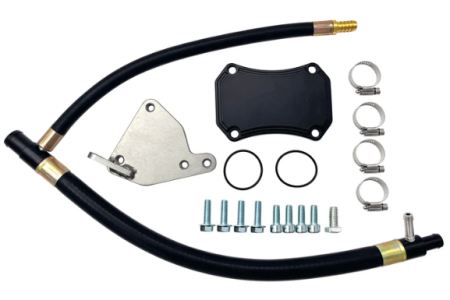
What distinguishes this kit from generic solutions is that it allows you to remove both the EGR valve and the cooler while retaining your factory intake and exhaust manifolds. That means no unnecessary fabrication, no hacking up factory components, and a cleaner installation overall. The three-terminal cooling hose re-routes coolant flow correctly, eliminating the cooler as both a heat source and a potential failure point. The included clamps and fasteners mean you're not hunting for hardware at the last minute.
For the 2011-2016 LML owner who understands the thermal and contamination costs of the stock EGR system, this kit addresses those issues at the source. It lowers coolant temperatures, prevents carbon ingestion, and removes a component that is fundamentally subject to fatigue. When paired with proper tuning, it transforms the engine's operating environment from one of regulatory compromise to one of mechanical efficiency.
If you've deleted the EGR on your LML, what changes did you notice in coolant temps, EGTs, or long-term durability—drop your experience below.
Last edited:
