

I learned this lesson the hard way about three years into owning my 2008 F-350. The truck had been running fine, pulling my gooseneck without complaint, getting the usual single-digit fuel economy that 6.4L owners learn to accept. But I kept noticing this faint ticking sound under heavy acceleration. Not loud enough to be alarming, but present enough that I started paying attention.
Then came the soot. Little black streaks on the firewall. Nothing major at first, but over a few months, it became obvious that something was escaping from somewhere it shouldn't.
A trip under the truck with a flashlight confirmed my suspicions. The factory up-pipes were leaking. Not catastrophically, but enough that I was losing boost and didn't even know it.
If you own a 6.4L Powerstroke, this is one of those problems that's almost guaranteed to show up eventually. The factory up-pipes have a known weak point, and understanding what fails and why can save you a lot of chasing your tail later.
The Job These Pipes Have to Do
The up-pipes on a 6.4L connect the exhaust manifolds to the Y-collector that feeds the turbochargers. They're responsible for taking exhaust gas from both banks and delivering it to the turbos with minimal loss of energy.
This is a demanding job. The exhaust coming out of those manifolds is hot—well over 1,000 degrees under load. The pipes have to handle that heat while also dealing with vibration from the engine, movement from the drivetrain, and the constant pressure pulses from each exhaust stroke.
The factory engineers designed these pipes with flexible bellows sections to accommodate all that movement and expansion. In theory, it's a solid design. In practice, those bellows become the weak link.
The 6.4L uses a sequential turbo setup, which means exhaust flow has to be managed precisely. The high-pressure turbo needs strong, consistent exhaust pressure to spool quickly. When the up-pipes leak, that pressure drops, and the whole system suffers.
Why Factory Pipes Don't Hold Up
The factory bellows are made from thin material that's prone to cracking after enough heat cycles. It doesn't happen all at once. It starts with hairline cracks that leak a little exhaust. Then the cracks grow, and the leaks get worse.
The material choice matters too. Factory pipes are often made from lower-grade steel that oxidizes and weakens over time. When you combine thin walls, cheap material, and constant thermal cycling, failure is really just a matter of when, not if.
Heat cycles are the enemy here. Every time you start a cold engine and bring it up to operating temperature, the pipes expand. Every time you shut it down, they contract. Do that a few thousand times, and metal fatigue sets in. The bellows are designed to flex, but they're also the thinnest part of the system, so they take the most stress.
What Happens When They Fail
The symptoms are pretty telltale. That ticking sound under acceleration is exhaust escaping before it reaches the turbos. The soot on your firewall is exhaust gases depositing carbon as they leak out. And the loss of performance? That's because you're losing drive pressure. The turbos aren't getting all the exhaust energy they need to spool properly.
A lot of guys chase boost issues on these trucks—replacing sensors, checking for leaks in the charge air system, even pulling turbos—when the real problem is right there at the up-pipes.
The 6.4L is already a complex engine. Adding boost leaks to the mix makes diagnosing other problems nearly impossible. You could spend weeks chasing sensors and codes, only to find that the whole time your up-pipes were leaking.
The Performance Cost
Leaking up-pipes cost you more than just a little noise. When exhaust escapes before the turbos, you lose drive pressure. The turbos have to work harder to build boost, which means they spool slower. Slower spool means more lag when you step on it.
Higher EGTs are another consequence. When the turbos aren't getting the exhaust energy they need, they can't move air as efficiently. That means hotter exhaust temps, which is never good for a diesel.
Fuel economy takes a hit too. The engine has to work harder to overcome the lack of boost, and that extra work shows up at the pump. A 6.4L already isn't winning any economy awards. Leaking up-pipes just make it worse.
What a Better Design Looks Like
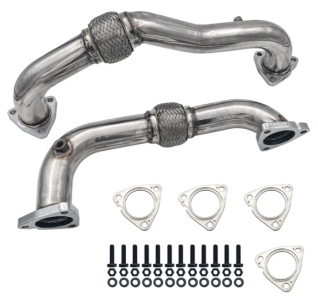
TruckTok 2008-2010 6.4L Ford Powerstroke Diesel Heavy Duty Exhaust Up-Pipe was used to compensate for shortcomings in the original design. The key differences lie in the materials and structure.
Stainless steel is a big upgrade over whatever the factory used. It handles heat better, resists corrosion, and doesn't fatigue as quickly. But the real difference is in how the flex sections are built.
Instead of thin, single-layer bellows that crack after enough cycles, better designs use reinforced interlocking braided construction. Think of it like a braided stainless brake line compared to a rubber hose. The braiding adds strength and durability while still allowing the flexibility needed to accommodate engine movement.
The rest of the pipe matters too. Precision machining ensures the flanges are flat and the bolt holes line up. If the flanges aren't true, you'll never get a good seal no matter how good the pipes are. And good welds mean the whole assembly holds together under the constant stress of expansion and contraction.
The Hardware Package
When you buy a set of these pipes, you're not just getting two pieces of tubing. A complete kit includes everything you need to do the job right. Gaskets are critical—using the wrong ones or reusing old ones guarantees leaks. The bolts and nuts should be new too, because the old ones are probably rusted and compromised.
Having all the hardware in one box saves a lot of frustration. Nothing worse than getting halfway through a job and realizing you're missing a bolt or need to make a parts store run.
What Installation Looks Like
Swapping up-pipes on a 6.4L isn't a small job. The engine bay is tight, and these pipes are buried in there. But it's doable for someone with decent mechanical skills and the right tools.
The factory pipes have to come out first, and that's usually where the swearing starts. The bolts that hold them in place have been through hundreds of heat cycles. They're often rusted, seized, and ready to snap if you look at them wrong. Penetrating oil and patience are your friends here.
Getting to everything requires removing some components that are in the way. The turbo inlet pipes, maybe the intake tubing, whatever else blocks access. It's not complicated, just time-consuming.
Once the old pipes are out, you clean up the mounting surfaces, install the new gaskets, and bolt the new pipes in place. The kit includes all the hardware, so you're not hunting for the right bolts at the last minute.
The new pipes should fit exactly. That's the point of precision engineering—they drop right in without modification. No bending, no grinding, no making things fit.
What Changes After the Swap
The most immediate difference you'll notice is the sound. That ticking or hissing under acceleration? Gone. The exhaust is staying where it belongs now.
Boost comes back too. With all that exhaust energy actually reaching the turbos, they spool faster and build boost more efficiently. The truck feels stronger, more responsive.
And that soot on your firewall? It stops accumulating. Clean it off once after the install and it stays clean.
EGTs usually drop as well. When the turbos can do their job properly, they move more air, which cools the exhaust. It's not a huge drop, but every degree helps when you're towing heavy.
Why This Matters for Long-Term Ownership
The 6.4L Powerstroke has a reputation that precedes it. These engines can be reliable, but they need attention to their weak points. The up-pipes are one of those points.
Leaking up-pipes don't just cost you performance. They also mess with the way the turbos work, which can lead to higher EGTs and more stress on the whole system. Fixing them removes that variable and lets everything else work the way it should.
For anyone planning to keep their 6.4L for the long haul, upgrading the up-pipes is one of those preventative measures that just makes sense. The factory pipes will fail eventually. Better to address it on your terms than to chase boost issues for months before figuring out what's really going on.
The Legal Side
These pipes are meant for off-road use only. If your truck has to pass emissions in a state that does visual inspections, this isn't the modification for you. Know your local laws and make your own call.
*If you've replaced the up-pipes on your 6.4L, what did you notice afterward? Drop your experience below.*
Then came the soot. Little black streaks on the firewall. Nothing major at first, but over a few months, it became obvious that something was escaping from somewhere it shouldn't.
A trip under the truck with a flashlight confirmed my suspicions. The factory up-pipes were leaking. Not catastrophically, but enough that I was losing boost and didn't even know it.
If you own a 6.4L Powerstroke, this is one of those problems that's almost guaranteed to show up eventually. The factory up-pipes have a known weak point, and understanding what fails and why can save you a lot of chasing your tail later.
The Job These Pipes Have to Do
The up-pipes on a 6.4L connect the exhaust manifolds to the Y-collector that feeds the turbochargers. They're responsible for taking exhaust gas from both banks and delivering it to the turbos with minimal loss of energy.
This is a demanding job. The exhaust coming out of those manifolds is hot—well over 1,000 degrees under load. The pipes have to handle that heat while also dealing with vibration from the engine, movement from the drivetrain, and the constant pressure pulses from each exhaust stroke.
The factory engineers designed these pipes with flexible bellows sections to accommodate all that movement and expansion. In theory, it's a solid design. In practice, those bellows become the weak link.
The 6.4L uses a sequential turbo setup, which means exhaust flow has to be managed precisely. The high-pressure turbo needs strong, consistent exhaust pressure to spool quickly. When the up-pipes leak, that pressure drops, and the whole system suffers.
Why Factory Pipes Don't Hold Up
The factory bellows are made from thin material that's prone to cracking after enough heat cycles. It doesn't happen all at once. It starts with hairline cracks that leak a little exhaust. Then the cracks grow, and the leaks get worse.
The material choice matters too. Factory pipes are often made from lower-grade steel that oxidizes and weakens over time. When you combine thin walls, cheap material, and constant thermal cycling, failure is really just a matter of when, not if.
Heat cycles are the enemy here. Every time you start a cold engine and bring it up to operating temperature, the pipes expand. Every time you shut it down, they contract. Do that a few thousand times, and metal fatigue sets in. The bellows are designed to flex, but they're also the thinnest part of the system, so they take the most stress.
What Happens When They Fail
The symptoms are pretty telltale. That ticking sound under acceleration is exhaust escaping before it reaches the turbos. The soot on your firewall is exhaust gases depositing carbon as they leak out. And the loss of performance? That's because you're losing drive pressure. The turbos aren't getting all the exhaust energy they need to spool properly.
A lot of guys chase boost issues on these trucks—replacing sensors, checking for leaks in the charge air system, even pulling turbos—when the real problem is right there at the up-pipes.
The 6.4L is already a complex engine. Adding boost leaks to the mix makes diagnosing other problems nearly impossible. You could spend weeks chasing sensors and codes, only to find that the whole time your up-pipes were leaking.
The Performance Cost
Leaking up-pipes cost you more than just a little noise. When exhaust escapes before the turbos, you lose drive pressure. The turbos have to work harder to build boost, which means they spool slower. Slower spool means more lag when you step on it.
Higher EGTs are another consequence. When the turbos aren't getting the exhaust energy they need, they can't move air as efficiently. That means hotter exhaust temps, which is never good for a diesel.
Fuel economy takes a hit too. The engine has to work harder to overcome the lack of boost, and that extra work shows up at the pump. A 6.4L already isn't winning any economy awards. Leaking up-pipes just make it worse.
What a Better Design Looks Like
TruckTok 2008-2010 6.4L Ford Powerstroke Diesel Heavy Duty Exhaust Up-Pipe was used to compensate for shortcomings in the original design. The key differences lie in the materials and structure.
Stainless steel is a big upgrade over whatever the factory used. It handles heat better, resists corrosion, and doesn't fatigue as quickly. But the real difference is in how the flex sections are built.
Instead of thin, single-layer bellows that crack after enough cycles, better designs use reinforced interlocking braided construction. Think of it like a braided stainless brake line compared to a rubber hose. The braiding adds strength and durability while still allowing the flexibility needed to accommodate engine movement.
The rest of the pipe matters too. Precision machining ensures the flanges are flat and the bolt holes line up. If the flanges aren't true, you'll never get a good seal no matter how good the pipes are. And good welds mean the whole assembly holds together under the constant stress of expansion and contraction.
The Hardware Package
When you buy a set of these pipes, you're not just getting two pieces of tubing. A complete kit includes everything you need to do the job right. Gaskets are critical—using the wrong ones or reusing old ones guarantees leaks. The bolts and nuts should be new too, because the old ones are probably rusted and compromised.
Having all the hardware in one box saves a lot of frustration. Nothing worse than getting halfway through a job and realizing you're missing a bolt or need to make a parts store run.
What Installation Looks Like
Swapping up-pipes on a 6.4L isn't a small job. The engine bay is tight, and these pipes are buried in there. But it's doable for someone with decent mechanical skills and the right tools.
The factory pipes have to come out first, and that's usually where the swearing starts. The bolts that hold them in place have been through hundreds of heat cycles. They're often rusted, seized, and ready to snap if you look at them wrong. Penetrating oil and patience are your friends here.
Getting to everything requires removing some components that are in the way. The turbo inlet pipes, maybe the intake tubing, whatever else blocks access. It's not complicated, just time-consuming.
Once the old pipes are out, you clean up the mounting surfaces, install the new gaskets, and bolt the new pipes in place. The kit includes all the hardware, so you're not hunting for the right bolts at the last minute.
The new pipes should fit exactly. That's the point of precision engineering—they drop right in without modification. No bending, no grinding, no making things fit.
What Changes After the Swap
The most immediate difference you'll notice is the sound. That ticking or hissing under acceleration? Gone. The exhaust is staying where it belongs now.
Boost comes back too. With all that exhaust energy actually reaching the turbos, they spool faster and build boost more efficiently. The truck feels stronger, more responsive.
And that soot on your firewall? It stops accumulating. Clean it off once after the install and it stays clean.
EGTs usually drop as well. When the turbos can do their job properly, they move more air, which cools the exhaust. It's not a huge drop, but every degree helps when you're towing heavy.
Why This Matters for Long-Term Ownership
The 6.4L Powerstroke has a reputation that precedes it. These engines can be reliable, but they need attention to their weak points. The up-pipes are one of those points.
Leaking up-pipes don't just cost you performance. They also mess with the way the turbos work, which can lead to higher EGTs and more stress on the whole system. Fixing them removes that variable and lets everything else work the way it should.
For anyone planning to keep their 6.4L for the long haul, upgrading the up-pipes is one of those preventative measures that just makes sense. The factory pipes will fail eventually. Better to address it on your terms than to chase boost issues for months before figuring out what's really going on.
The Legal Side
These pipes are meant for off-road use only. If your truck has to pass emissions in a state that does visual inspections, this isn't the modification for you. Know your local laws and make your own call.
*If you've replaced the up-pipes on your 6.4L, what did you notice afterward? Drop your experience below.*
Last edited:
