

The 2011-2015 LML Duramax represents a significant evolution in GM's diesel platform. It introduced a high-pressure common-rail system with piezo injectors, a CP4.2 pump, and a more complex emissions architecture that combined cooled EGR with a Diesel Exhaust Fluid system. The engine makes impressive power and torque numbers straight from the factory, but beneath those numbers lies a series of engineering compromises that affect airflow, throttle response, and thermal efficiency.
One of the most overlooked restrictions in the LML's intake system sits between the throttle body and the intake manifold: the factory intake bridge. This seemingly simple component plays a critical role in how air flows from the turbocharger, through the intercooler, and finally into the cylinders. Understanding why the factory part limits performance requires examining the specific engineering decisions that shaped its design and the consequences they create for engine operation.
The material compromise: Plastic is lightweight and inexpensive, but it lacks the thermal stability and structural rigidity of aluminum. Underhood temperatures cause plastic to expand and contract, and over time, the material can become brittle. The factory bridge is also subject to heat soak, absorbing heat from the engine and transferring it to the intake air.
The geometry compromise: The factory bridge incorporates tight-radius bends and abrupt transitions that prioritize packaging over airflow. These geometric features create turbulence and restriction, forcing the turbocharger to work harder to deliver the same mass of air to the cylinders.
The resonator compromise: The factory bridge includes a resonator chamber designed to attenuate intake noise. While effective at reducing sound, this resonator disrupts airflow and creates additional turbulence. The air must navigate around and through this chamber, losing energy and flow efficiency in the process.
The diameter compromise: The factory bridge's internal diameter is smaller than optimal for high-flow applications. While adequate for stock power levels, this restriction becomes a bottleneck when airflow demands increase—whether from tuning, towing, or simply operating at high RPM under load.
The path: Compressed air leaves the turbo at temperatures that can exceed 300°F under load. It travels through the intercooler, where heat is removed, then through charge air piping, and finally through the intake bridge into the intake manifold.
The challenge: Every bend, every transition, and every surface irregularity creates flow separation and turbulence. Turbulent flow has higher frictional losses than laminar flow, which means the turbo must work harder to deliver the same mass of air to the cylinders.
The bridge's role: As the final component before the intake manifold, the intake bridge has an outsized influence on how air is distributed to the cylinders. A poorly designed bridge can create uneven flow distribution, starving some cylinders of air while over-supplying others. This affects combustion quality, power output, and emissions.
The 80 percent claim: The product information states that the replacement bridge increases airflow by 80 percent. This figure comes from comparing the flow capacity of the factory plastic bridge with the optimized aluminum replacement. The improvement derives from three factors: larger internal diameter, smoother bends, and elimination of the restrictive resonator. An 80 percent improvement in flow capacity does not translate to an 80 percent power gain, but it does mean the engine can breathe more freely, particularly at higher RPM and boost levels where flow becomes the limiting factor.
How resonators work: Resonator chambers create a Helmholtz effect that cancels specific sound frequencies. They do this by providing a volume of air adjacent to the main flow path that resonates at frequencies opposite to the unwanted noise.
The flow consequence: The resonator chamber creates a dead-end volume adjacent to the main airflow. Air entering this chamber must exit, creating turbulence and flow separation at the junction. This disruption reduces effective flow area and increases the pressure drop across the bridge.
The resonator delete block: The kit includes a block-off plate that eliminates the resonator entirely. Removing this feature does two things: it eliminates the turbulence caused by the resonator chamber, and it smooths the internal surface of the bridge, allowing laminar flow to develop.
Thermal conductivity: Aluminum conducts heat approximately 300 times better than plastic. This means the bridge acts as a heat sink, helping to cool the intake air slightly before it enters the manifold. Every degree of temperature reduction increases air density and improves combustion efficiency.
Thermal stability: Aluminum maintains its mechanical properties across the full range of underhood temperatures. Unlike plastic, which softens with heat and becomes brittle with age, aluminum remains dimensionally stable indefinitely.
Strength and rigidity: Aluminum's higher strength allows for thinner walls and larger internal passages without compromising structural integrity. The bridge can be designed for maximum flow while still providing a rigid mounting point for sensors and components.
Corrosion resistance: Aluminum naturally forms a protective oxide layer that resists corrosion from the chemical environment under the hood. Unlike steel, it will not rust, and unlike plastic, it will not degrade when exposed to oil vapor and fuel vapors.
Square flange design: The square flange provides a stable mounting surface that distributes clamping force evenly. This prevents warping and ensures that the O-ring or gasket seals properly under all operating conditions.
TIG welding: Tungsten Inert Gas welding produces clean, strong, and aesthetically pleasing welds. Unlike MIG welding, which can leave spatter and inconsistent penetration, TIG welding allows precise control over heat input and filler material. The result is a weld that is both structurally sound and smooth internally, with no protrusions to disrupt airflow.
Pressure testing: Each bridge is pressure tested to guarantee no leakage. This is critical because any leak in the intake system after the turbocharger represents lost boost pressure and reduced performance. A leak that might be acceptable in other locations is unacceptable in the high-pressure intake tract.
Mandrel bending: When a tube is bent without internal support, the outer wall stretches thin and the inner wall buckles, creating a restriction. Mandrel bending uses an internal support to maintain consistent cross-sectional area throughout the bend. This preserves flow capacity and prevents the localized velocity increases that create pressure drops.
Large radius bends: The radius of a bend affects flow efficiency. Tight radius bends create flow separation and turbulence. Large radius bends allow the air to change direction gradually, maintaining laminar flow and minimizing losses.
The cumulative effect: Larger diameter, mandrel-bent tubing with generous radii creates an intake path that flows significantly more air than the factory bridge. This translates to reduced restriction, faster turbo spool, and improved throttle response.
Throttle response: The engine responds more immediately to driver input, reducing the lag between pedal movement and acceleration.
Lower EGTs: When the engine can breathe more efficiently, combustion becomes more complete, and less energy is wasted as heat in the exhaust stream. Lower EGTs reduce thermal stress on the turbocharger, exhaust valves, and other components.
Increased performance: With reduced restriction, the turbocharger operates more efficiently. It can deliver the same boost pressure with less work, or more boost pressure with the same work. The "increased performance" and "optimize airflow behind throttle and heater" claims reflect the reality that an engine not fighting intake restriction can devote more energy to propulsion.
Turbo spool: The turbocharger spools more quickly and maintains boost more effectively when the intake system is free-flowing.
Why delete the resonator: The factory resonator serves only to reduce intake noise. It has no performance function and actually degrades flow by creating turbulence. Removing it eliminates this turbulence and smooths the intake path.
The block-off plate design: The delete block is precision-machined to match the factory mounting points. It installs using the existing hardware and creates a smooth internal surface that promotes laminar flow.
The acoustic trade-off: Eliminating the resonator does change the sound of the intake. Some owners prefer the more aggressive induction noise that results. Others may find it louder than desired. This is a subjective trade-off, but from a performance standpoint, the resonator serves no beneficial function.
The tuning connection: For owners who plan to tune their LML, the intake bridge becomes even more critical. Tuning increases fueling, which requires increased airflow to maintain proper air-fuel ratios. A restricted intake system becomes a bottleneck that limits the effectiveness of tuning.
The towing application: For owners who use their trucks for heavy towing, the intake bridge's effect on EGTs is particularly important. Lower EGTs under load mean less thermal stress on the engine and longer component life. The improved airflow from a properly designed bridge contributes directly to this benefit.
The TruckTok 2011-2015 6.6L GMC Chevrolet Duramax LML Diesel Intake Elbow Bridge Kit addresses these deficiencies through engineering choices that matter:
For LML owners who understand that airflow is the foundation of performance, this intake bridge provides a permanent, maintenance-free solution to one of the factory engine's most significant restrictions.
One of the most overlooked restrictions in the LML's intake system sits between the throttle body and the intake manifold: the factory intake bridge. This seemingly simple component plays a critical role in how air flows from the turbocharger, through the intercooler, and finally into the cylinders. Understanding why the factory part limits performance requires examining the specific engineering decisions that shaped its design and the consequences they create for engine operation.
Part 1: The Factory Intake Bridge – A Study in Compromise
The LML Duramax factory intake bridge is manufactured from plastic and designed to meet multiple objectives that have little to do with performance. Cost reduction, noise attenuation, and packaging constraints all influenced its final form.The material compromise: Plastic is lightweight and inexpensive, but it lacks the thermal stability and structural rigidity of aluminum. Underhood temperatures cause plastic to expand and contract, and over time, the material can become brittle. The factory bridge is also subject to heat soak, absorbing heat from the engine and transferring it to the intake air.
The geometry compromise: The factory bridge incorporates tight-radius bends and abrupt transitions that prioritize packaging over airflow. These geometric features create turbulence and restriction, forcing the turbocharger to work harder to deliver the same mass of air to the cylinders.
The resonator compromise: The factory bridge includes a resonator chamber designed to attenuate intake noise. While effective at reducing sound, this resonator disrupts airflow and creates additional turbulence. The air must navigate around and through this chamber, losing energy and flow efficiency in the process.
The diameter compromise: The factory bridge's internal diameter is smaller than optimal for high-flow applications. While adequate for stock power levels, this restriction becomes a bottleneck when airflow demands increase—whether from tuning, towing, or simply operating at high RPM under load.
Part 2: The Fluid Dynamics of Intake Flow
To understand why the intake bridge matters, consider what happens to air as it travels from the turbocharger compressor outlet to the intake manifold.The path: Compressed air leaves the turbo at temperatures that can exceed 300°F under load. It travels through the intercooler, where heat is removed, then through charge air piping, and finally through the intake bridge into the intake manifold.
The challenge: Every bend, every transition, and every surface irregularity creates flow separation and turbulence. Turbulent flow has higher frictional losses than laminar flow, which means the turbo must work harder to deliver the same mass of air to the cylinders.
The bridge's role: As the final component before the intake manifold, the intake bridge has an outsized influence on how air is distributed to the cylinders. A poorly designed bridge can create uneven flow distribution, starving some cylinders of air while over-supplying others. This affects combustion quality, power output, and emissions.
The 80 percent claim: The product information states that the replacement bridge increases airflow by 80 percent. This figure comes from comparing the flow capacity of the factory plastic bridge with the optimized aluminum replacement. The improvement derives from three factors: larger internal diameter, smoother bends, and elimination of the restrictive resonator. An 80 percent improvement in flow capacity does not translate to an 80 percent power gain, but it does mean the engine can breathe more freely, particularly at higher RPM and boost levels where flow becomes the limiting factor.
Part 3: The Resonator Problem – More Than Just Noise
The factory intake bridge includes a resonator chamber specifically designed to attenuate intake noise. While effective at its intended purpose, this feature has significant aerodynamic consequences.How resonators work: Resonator chambers create a Helmholtz effect that cancels specific sound frequencies. They do this by providing a volume of air adjacent to the main flow path that resonates at frequencies opposite to the unwanted noise.
The flow consequence: The resonator chamber creates a dead-end volume adjacent to the main airflow. Air entering this chamber must exit, creating turbulence and flow separation at the junction. This disruption reduces effective flow area and increases the pressure drop across the bridge.
The resonator delete block: The kit includes a block-off plate that eliminates the resonator entirely. Removing this feature does two things: it eliminates the turbulence caused by the resonator chamber, and it smooths the internal surface of the bridge, allowing laminar flow to develop.
Part 4: The Material Science Advantage – Aluminum Alloy Construction
The replacement bridge is constructed from aluminum alloy, a material choice that offers several significant advantages over the factory plastic.Thermal conductivity: Aluminum conducts heat approximately 300 times better than plastic. This means the bridge acts as a heat sink, helping to cool the intake air slightly before it enters the manifold. Every degree of temperature reduction increases air density and improves combustion efficiency.
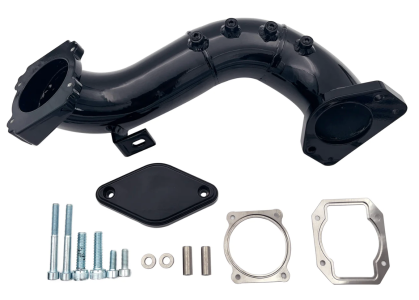
Thermal stability: Aluminum maintains its mechanical properties across the full range of underhood temperatures. Unlike plastic, which softens with heat and becomes brittle with age, aluminum remains dimensionally stable indefinitely.
Strength and rigidity: Aluminum's higher strength allows for thinner walls and larger internal passages without compromising structural integrity. The bridge can be designed for maximum flow while still providing a rigid mounting point for sensors and components.
Corrosion resistance: Aluminum naturally forms a protective oxide layer that resists corrosion from the chemical environment under the hood. Unlike steel, it will not rust, and unlike plastic, it will not degrade when exposed to oil vapor and fuel vapors.
Part 5: The Manufacturing Precision – CNC Machining and TIG Welding
CNC machining: Computer-controlled machining produces components with precise tolerances and consistent quality. The mounting flanges are perfectly flat, ensuring leak-free sealing against the intake manifold and throttle body. The bolt holes align exactly with factory locations, making installation straightforward.Square flange design: The square flange provides a stable mounting surface that distributes clamping force evenly. This prevents warping and ensures that the O-ring or gasket seals properly under all operating conditions.
TIG welding: Tungsten Inert Gas welding produces clean, strong, and aesthetically pleasing welds. Unlike MIG welding, which can leave spatter and inconsistent penetration, TIG welding allows precise control over heat input and filler material. The result is a weld that is both structurally sound and smooth internally, with no protrusions to disrupt airflow.
Pressure testing: Each bridge is pressure tested to guarantee no leakage. This is critical because any leak in the intake system after the turbocharger represents lost boost pressure and reduced performance. A leak that might be acceptable in other locations is unacceptable in the high-pressure intake tract.
Part 6: The Diameter and Bend Radius – Optimizing Flow
Diameter considerations: Flow capacity increases with the square of the diameter. A modest increase in diameter produces a significant increase in flow area. The factory bridge's smaller diameter becomes a bottleneck when airflow demands increase, creating a pressure drop that the turbo must overcome.Mandrel bending: When a tube is bent without internal support, the outer wall stretches thin and the inner wall buckles, creating a restriction. Mandrel bending uses an internal support to maintain consistent cross-sectional area throughout the bend. This preserves flow capacity and prevents the localized velocity increases that create pressure drops.
Large radius bends: The radius of a bend affects flow efficiency. Tight radius bends create flow separation and turbulence. Large radius bends allow the air to change direction gradually, maintaining laminar flow and minimizing losses.
The cumulative effect: Larger diameter, mandrel-bent tubing with generous radii creates an intake path that flows significantly more air than the factory bridge. This translates to reduced restriction, faster turbo spool, and improved throttle response.
Part 7: The Performance Outcomes
When the factory plastic intake bridge is replaced with a properly engineered aluminum unit, several measurable improvements occur.Throttle response: The engine responds more immediately to driver input, reducing the lag between pedal movement and acceleration.
Lower EGTs: When the engine can breathe more efficiently, combustion becomes more complete, and less energy is wasted as heat in the exhaust stream. Lower EGTs reduce thermal stress on the turbocharger, exhaust valves, and other components.
Increased performance: With reduced restriction, the turbocharger operates more efficiently. It can deliver the same boost pressure with less work, or more boost pressure with the same work. The "increased performance" and "optimize airflow behind throttle and heater" claims reflect the reality that an engine not fighting intake restriction can devote more energy to propulsion.
Turbo spool: The turbocharger spools more quickly and maintains boost more effectively when the intake system is free-flowing.
Part 8: The Resonator Delete Block – Eliminating a Restriction
The kit includes a resonator delete block and all required hardware. This component replaces the factory resonator with a smooth, uninterrupted passage.Why delete the resonator: The factory resonator serves only to reduce intake noise. It has no performance function and actually degrades flow by creating turbulence. Removing it eliminates this turbulence and smooths the intake path.
The block-off plate design: The delete block is precision-machined to match the factory mounting points. It installs using the existing hardware and creates a smooth internal surface that promotes laminar flow.
The acoustic trade-off: Eliminating the resonator does change the sound of the intake. Some owners prefer the more aggressive induction noise that results. Others may find it louder than desired. This is a subjective trade-off, but from a performance standpoint, the resonator serves no beneficial function.
Part 9: The Fitment – Direct Replacement
The kit is designed as a direct replacement for the factory intake bridge on 2011-2015 LML Duramax applications. It fits:- 2011-2015 Chevrolet Silverado 2500/3500 with LML Duramax
- 2011-2015 GMC Sierra 2500/3500 with LML Duramax
Part 10: The LML-Specific Context
The LML Duramax represents a particular moment in diesel evolution. It was the first Duramax to combine high-pressure common-rail injection with a CP4.2 pump and comprehensive emissions equipment. The engine makes excellent power in stock form, but its intake system was designed with constraints that limit its potential.The tuning connection: For owners who plan to tune their LML, the intake bridge becomes even more critical. Tuning increases fueling, which requires increased airflow to maintain proper air-fuel ratios. A restricted intake system becomes a bottleneck that limits the effectiveness of tuning.
The towing application: For owners who use their trucks for heavy towing, the intake bridge's effect on EGTs is particularly important. Lower EGTs under load mean less thermal stress on the engine and longer component life. The improved airflow from a properly designed bridge contributes directly to this benefit.
Part 11: The Technical Verdict
The 2011-2015 LML Duramax factory intake bridge is a compromise between cost, noise control, and performance. Its plastic construction, restrictive geometry, and integral resonator all limit airflow and increase intake temperatures. For owners seeking to optimize their engine's breathing, replacing this component represents a fundamental improvement.The TruckTok 2011-2015 6.6L GMC Chevrolet Duramax LML Diesel Intake Elbow Bridge Kit addresses these deficiencies through engineering choices that matter:
- Aluminum alloy construction for thermal benefits and durability
- Resonator delete block to eliminate turbulence
- Larger diameter, mandrel-bent tubing for increased flow
- Full TIG welding and CNC machined flanges for perfect sealing
- Pressure testing to guarantee no leaks
For LML owners who understand that airflow is the foundation of performance, this intake bridge provides a permanent, maintenance-free solution to one of the factory engine's most significant restrictions.
Last edited:
